
On July 1, 2021, college athletics entered a new era. For the first time, NCAA student-athletes could profit from their Name, Image and Likeness.
The NIL Era transformed college sports almost overnight — a new economy built around endorsement deals, collectives, the transfer portal, revenue sharing, recruiting battles and athlete compensation.
Those stories have dominated headlines for five years. Understandably so.
But after spending those same five years working with hundreds of athletes, coaches, administrators and parents, I’ve become convinced the biggest story of the NIL Era isn’t about money.
It’s about Opportunity.
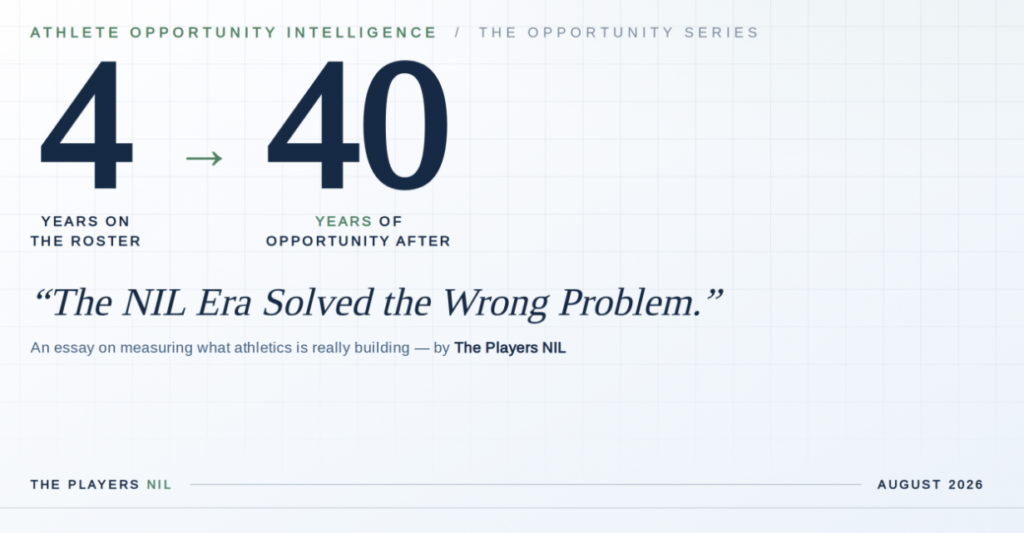
More specifically: whether we’re preparing athletes for the next forty years of their lives as intentionally as we’ve prepared them for the next four.
The Conversation Has Focused on the Two Percent
If you only followed college athletics through national headlines, you might conclude every athlete is negotiating endorsement contracts or picking schools based on collective payouts.
That isn’t reality.
- 500,000+ NCAA student-athletes compete each year.
- Fewer than 2% will compete professionally or at the Olympic level.
- More than 98% will build careers outside professional sports.
The headlines focus on the two percent. The opportunity belongs to the ninety-eight percent.
For five years, the industry has asked: “How much money can athletes earn?”
The better question might be: “What is the NIL Era actually preparing athletes for?”
The Real NIL Opportunity
Sport has never commanded more attention. During the 2026 FIFA World Cup, more than 6.8 million fans attended matches across 104 games, stadiums ran at 99.7% occupancy, and the final between Spain and Argentina drew a combined 62.8 million U.S. viewers. Visibility is becoming one of the world’s most valuable currencies. The question is whether athletes know how to convert that visibility into lifelong opportunity.
From the beginning, The Players NIL has operated from one belief: athletes have never been celebrated more than they are today. Sports dominate television, streaming, social media, podcasts, local news and community life. Every day, we consume stories about athletes’ victories, failures, routines, personalities and leadership.
That attention creates something more valuable than most people realize: opportunity.
Not just for the quarterback at Alabama. Not just for the Final Four star. For every athlete — the volleyball player known throughout her hometown, the Division III swimmer inspiring kids at the local YMCA, the soccer player volunteering in her community, the baseball player whose professors and local business leaders already know his name.
These athletes may never sign a six-figure NIL deal. But they carry something just as valuable: visibility, trust, credibility, relationships, and a story worth telling. Those assets can become the foundation of lifelong opportunity.
That, in my opinion, is the real NIL opportunity — and much of that conversation has been overshadowed by the business of college athletics.
The Workplace Changed While We Were Watching Sports
Something else happened during the NIL Era’s first five years: the workplace fundamentally changed.
The World Economic Forum’s Future of Jobs Report 2025 found employers expect 39% of today’s core workplace skills to change by 2030. Analytical thinking now ranks as the single most important workplace skill globally, alongside resilience, adaptability, curiosity, leadership and social influence.
The National Association of Colleges and Employers reports that 70% of employers now use skills-based hiring for entry-level talent, and LinkedIn’s own Economic Graph data shows employers increasingly searching for demonstrated capability over degrees or job titles.
Meanwhile, a landmark Strada-Gallup study of more than 32,000 college students found only 34% strongly believe they’ll graduate with the skills and knowledge to succeed in the job market — despite career advancement being the top reason most students enroll in college in the first place.
The message is unmistakable: the future belongs to people who can think critically, adapt continuously, collaborate effectively and lead others through change.
Athletics Is Already Building These Skills
This is where college athletics has an extraordinary, underused advantage.
Every day, athletes practice the exact capabilities employers now value most. Reviewing film builds analytical thinking. Learning a new system builds adaptability. Returning from injury builds resilience. Leading teammates builds communication and influence. Balancing academics and athletics builds discipline and prioritization. Performing under pressure builds confidence. Constant coaching builds the ability to accept feedback and improve.
College athletics may be one of the greatest human-skills laboratories in higher education.
Yet very few athletes are ever taught how to translate those experiences into professional opportunity. Knowing how to overcome adversity is one thing. Explaining that experience in a job interview is something else entirely. Leading a team isn’t automatically recognized by an employer unless an athlete can clearly articulate why it matters.
Athletics develops remarkable people. We now need to help athletes turn those experiences into professional capital.
From Human Skills to Opportunity
NCAA’s most recent GOALS research — surveying more than 20,000 student-athletes across 493 schools — found more than 80% of student-athletes credit college athletics with developing leadership, goal-setting, time management and the ability to perform under pressure.
The skills are clearly there. Communication remains one of the most requested competencies among employers, yet many former athletes still struggle to translate their experience into interviews, internships and professional relationships.
Athletics isn’t failing to build skills. It’s failing to convert them.
That distinction changes everything. The challenge is no longer helping athletes develop leadership, resilience or teamwork — athletics has done that exceptionally well for decades. The challenge is helping athletes recognize those capabilities, communicate them effectively, and leverage them into internships, mentors and meaningful career opportunities.
Athletics doesn’t have a human-skills problem. It has an opportunity-conversion problem.
From Attendance to Outcomes
Colleges and universities have invested heavily in student-athlete development — leadership academies, financial literacy programs, community engagement, career workshops, mental wellness initiatives.
Those investments matter. But they raise an important question: how do we know they’re working?
Most departments can tell you how many athletes attended a workshop. Far fewer can answer:
- How many athletes graduate with meaningful professional mentors?
- How many have completed internships?
- How many have built relationships with alumni in their desired field?
- How many can confidently articulate the value of their athletic experience?
- How many leave campus with a network capable of opening doors five years later?
These may become the defining questions of the next generation of athlete development.
Looking Forward
I don’t believe the next chapter of the NIL Era will be written through bigger endorsement deals or more sophisticated revenue-sharing models.
I believe it will be written by institutions that intentionally prepare athletes to convert four years of athletic participation into forty years of professional opportunity.
That requires more than good programming. It requires a new way of thinking — and eventually, a new way of measuring success.
Over the coming months, I’ll be exploring that question through research, conversations with athletic leaders nationwide, and the development of a framework I’m calling Athlete Opportunity Intelligence (AOI) — not because athletics needs another program, but because the opportunities athletics creates deserve to be understood, measured and expanded.
Five Questions Every Athlete Should Be Able to Answer Before Graduation
- What does success look like after sports?
- Who knows me professionally?
- Can I clearly communicate my story and the skills athletics has given me?
- What opportunities am I intentionally creating today?
- If my athletic career ended tomorrow, how prepared would I be for what comes next?
Final Thought
Five years into the NIL Era, perhaps the greatest value of Name, Image and Likeness was never the chance to monetize athletic performance.
Perhaps it was something larger: a challenge to think differently about who athletes are, how they’re perceived, and how they can use athletics to create opportunity beyond competition.
The athletes who understand that distinction won’t just leave college with memories of the games they played. They’ll leave with relationships, experiences and opportunities that shape the rest of their lives.
Maybe that’s the scoreboard we’ve been missing.
I’d Love Your Perspective
I’m building Athlete Opportunity Intelligence in the open, and right now the most useful data isn’t coming from spreadsheets — it’s coming from conversations like this one.
If you’re an athletic director, coach, student-athlete development professional, or work in career services or NIL, I’d genuinely value your take:
- Is a framework like this something your department would see real value in?
- If it existed today, would your institution invest in it?
- What would it need to include to be worth budgeting for?
Add your comment — I read every one, and your answer may directly shape what we build next.