
Athlete Opportunity Intelligence: Measuring Career Readiness
Six weeks ago, we started making a case one piece at a time. Athletes already have real networks — coaches, teammates, alumni — but rarely learn how to turn them into opportunity. Experience compounds before graduation, and right now it isn’t distributed evenly. Ownership of career readiness is split across half a dozen offices, which too often means no one actually owns it.
Underneath all of it sits one number: the Chronicle of Higher Education surveyed 378 student-success professionals in 2026 and found that career-related outcomes ranked dead last — 9th out of 9 — among the goals institutions track for student success. We track who stays enrolled. We track who crosses the stage. We rarely track whether the diploma actually opened a door.
That’s the argument. Here’s what we think answering it requires.
The Question Every Athletic Department Is About to Get Asked
College presidents and boards are about to put athletic departments under a microscope they haven’t faced before — not “did you win,” but “what did this cost, and what did it deliver.” Revenue-sharing dollars are being allocated across rosters in ways that are, for the first time, genuinely a data question. Presidents are going to ask their athletic departments directly: what value are we delivering to our student-athletes?
That question doesn’t have one answer. A football or basketball player on scholarship at a Power conference program is not a Division II swimmer, and the honest answer an athletic department gives is going to look different for each of them. Any framework that pretends otherwise isn’t measuring anything real.
Introducing Athlete Opportunity Intelligence
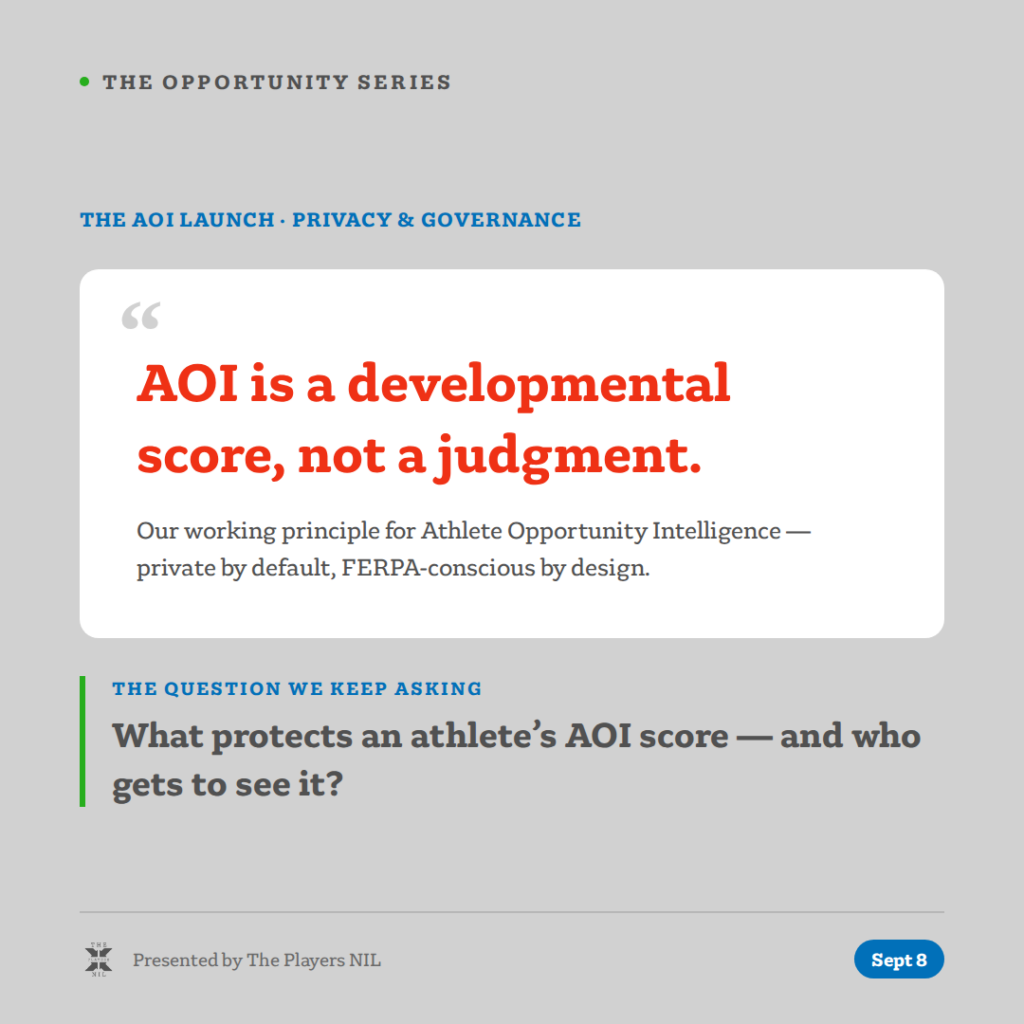
We’re calling it Athlete Opportunity Intelligence — AOI, for short. It’s a measurement framework for how prepared a student-athlete actually is for life after sports.
To be clear about what it isn’t: it’s not a brand campaign, it’s not another satisfaction survey, and it’s not a replacement for the work career services and academic support already do. It’s a way to make that work visible — to know, rather than assume, whether it’s landing.
The Optimism Penalty
Here’s the finding that made us build this. The NCAA’s own April 2026 SNAP survey — 5,603 respondents across 158 Division I schools — asked athletes about 14 specific career-preparation actions: building a LinkedIn profile, doing an informational interview, attending a career fair, and so on.
Athletes who consider a pro or Olympic career “likely” take meaningfully fewer of those actions than athletes who don’t. They’re roughly twice as likely to have taken none of the 14 — 26% versus 13% for men’s sports, 17% versus 8% for women’s — and they trail by 10 to 20 points across nearly every individual action.
Believing you’ll go pro isn’t the problem. It appears to quietly delay building the alternative path — and until now, nobody had a number for that. (Worth noting: SNAP respondents aren’t a nationally representative sample of Division I athletes, so we’re citing this as what SNAP respondents show, not a universal claim.)
Why One Score Can’t Answer for Everyone
The NCAA’s own GOALS data makes the same point from a different angle. Internship participation by division: 69% at Division III, 53% at Division II, 48% at Division I — where athletes cite sport-schedule conflicts as the top barrier.
The question “are we preparing athletes for life after sports” doesn’t have the same answer for a Power conference football roster and the 98% of athletes competing in Olympic sports, non-revenue sports, and Division II or III programs. A framework that can’t account for that difference is a single curve pretending to fit every program. AOI is built to score against context, not against one national average.
What AOI Actually Measures
AOI looks at four domains:
- Visibility — professional profile, story, portfolio
- Relationships — alumni, mentors, employers, distinct from the family and teammate network athletes already have
- Experience — internships, shadowing, informational interviews, leadership roles
- Opportunity — interviews, offers, graduate school, employment
We’re being direct about where the line sits: the scoring methodology and the benchmarking data behind it are proprietary. What we’re not selling is the diagnosis — the gaps, and why they matter. That part we’re showing, not gating.
A Process, Not a Survey
What does it actually look like to close these gaps? Not another one-time questionnaire — a cycle, the same one that works for anything an institution genuinely wants to improve:
Baseline. Where does an athlete stand today, across the four domains? You can’t close a gap you haven’t measured.
Benchmark. Compared to what? A number alone means nothing without something to measure it against — peers, sport, class year.
Intervention. Once the gap is visible, close it — an alumni introduction, an internship connection, a résumé workshop. Targeted, not generic.
Reassessment. Check again. Did it actually move the number, or did it just feel productive?
Reporting. Show the athlete, the department, and eventually the institution what changed.
That’s the difference between “we ran career programming” and “we know it worked” — the same shift that changed how front offices evaluate talent. Not more effort. A way to measure the effort already happening that can survive an argument.
This Isn’t Theoretical
A few places are already doing pieces of this:
- The University of North Texas built a “time to value” metric and reallocated $130 million a year based on it — proof that ROI-style measurement can actually move institutional decisions, not just describe them.
- UC Davis’s Aggie EVO program has required every student-athlete to build a LinkedIn profile, complete informational interviews, and check in quarterly since 2017–18 — proof that “embedded, not voluntary” already has a multi-year track record, not just a theory.
- Babson pairs every first-year student with both an academic adviser and a career adviser, and publishes a first-destination outcomes dashboard — proof that institutions are already willing to make this visible once they have the data to back it up.
None of these were built as an “AOI.” Each is a real institution deciding that career readiness deserved the same rigor as anything else it measures.
What Would It Take?
We didn’t spend six weeks building a case for a product. We spent six weeks building a case for a question: what would it take for your department to know — not assume — that your athletes are prepared for what comes after?
If you want to see the framework directly, request the one-page AOI preview — link in comments.
Sources: Chronicle of Higher Education, “The Future of Student Success” (2026, n=378); NCAA SNAP Survey (April 2026, n=5,603, 158 Division I institutions); NCAA GOALS Study (2026); University of North Texas; UC Davis Aggie EVO; Babson College.