

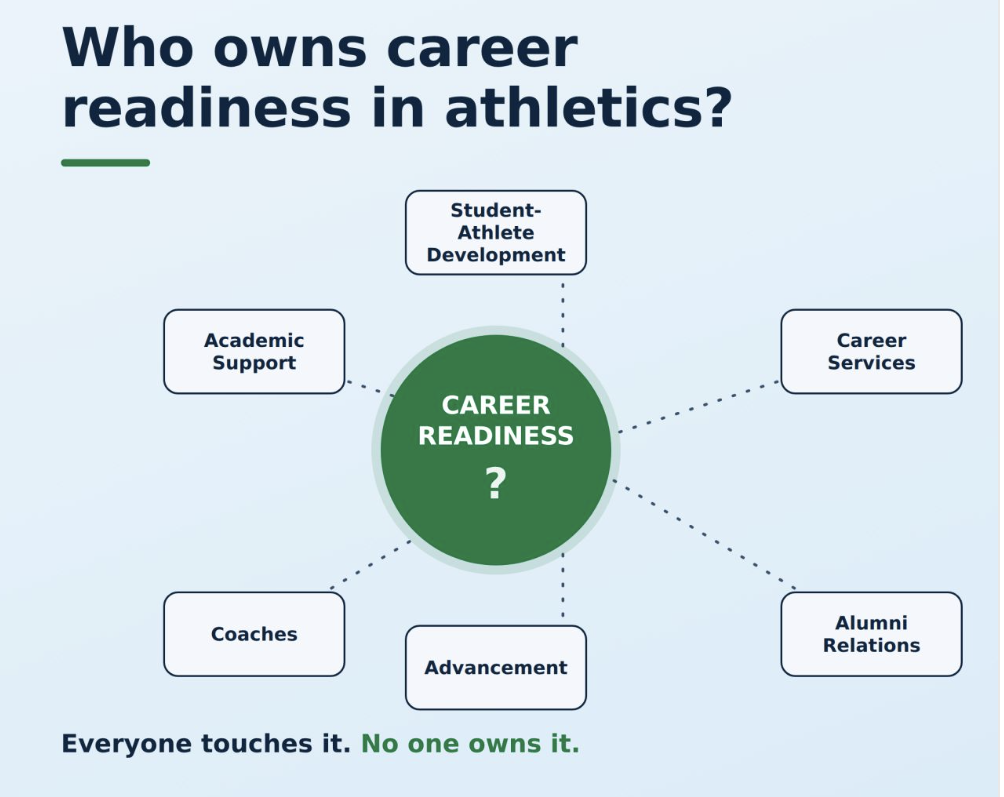
The Question
Colleges spend heavily on athletics and say the experience prepares athletes for life after sports. We asked a narrower question that is easy to check: in a college athletics department, who is accountable for helping athletes build real professional relationships (mentors, alumni, employers), and does anyone measure whether it works?
Before looking, we wrote down a hypothesis that could have been wrong: dedicated accountability for this work is uncommon, and where networking exists it is usually one duty inside a broader role (career development, alumni engagement, NIL, or student-athlete development) rather than a job of its own.
What We Did
Sample. 50 NCAA athletics departments: 10 each from five groups (Power 4 FBS, other FBS, FCS, Division II, Division III). Schools were drawn at random, using a recorded random seed, from public lists of NCAA member institutions for each group. We did not pick schools from our own contacts or network.
Evidence. Public sources only: athletics staff directories and biographies, program pages, job postings, and news releases. Every finding was recorded with its source and date. We did not contact any school, and we used no student data.
Categories. Each school was assigned one category:
- A: a role whose primary purpose is building athletes’ professional relationships (mentors, alumni, or employers).
- B: that responsibility is explicitly documented as part of a broader role.
- C: networking activity exists (events, programs), but no accountable role is named.
- D: no public evidence found.
The categories and the hypothesis were set before coding began. “D” means we did not find evidence in public sources. It does not mean nothing exists.
Coding and review. Every school was coded twice. The second coding was done blind, without seeing the first result, using written tie-break rules (for example: a campus-wide alumni program with no documented link to athletics does not count; a generic title with no stated duties does not count as B; duties that appear only in an old job posting count for less). Every school placed in A or B was then re-read directly against its live page, and disputed schools got a third look. The research and first-pass coding were done with AI research assistants following these written rules; AOI reviewed and reconciled the results.
Agreement. On the 23 hardest schools, the two coders agreed only 52% of the time before the written rules existed. Across all 50, the two passes agreed on 74% of schools before the final live-page check, and that check moved more schools down than up (the count of schools with an explicit duty inside a broader role fell from 13 in the first pass to 6). The tie-break rules were written after the first pass exposed those disagreements. We report this because disagreement on the hard cases is itself a finding: without written rules, reasonable reviewers classify the same department differently.
What We Found
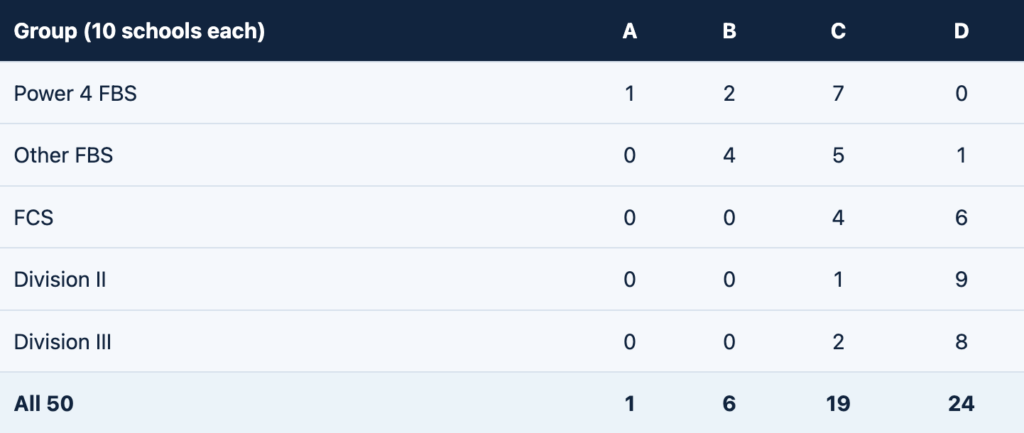
- At most one of the 50 had a role whose primary purpose is building athletes’ professional relationships. Under the strictest reading of our rules, none did.
- Six more documented the responsibility as one duty inside a broader role.
- In the other 43, networking appeared only as events or campus programs with no named owner (19), or we found no public evidence of an owner (24).
- Seven of 20 FBS departments had a named owner or duty; none of the 30 in FCS, Division II, and Division III did.
- Only 2 of 50 published any outcome figure. One was several years old; one was self-reported. Neither shows whether relationships created the opportunity.
What This Does Not Show
- It is not proof that schools do nothing. Departments may do real work that is not visible in public sources, especially below FBS, where public staff pages are thinner and often list names only. Some of the gap between FBS and the rest is visibility.
- It does not measure effectiveness. We looked at ownership and visible measurement, not whether athletes receive introductions or get jobs.
- It is a small sample. Ten schools per group is enough to show a pattern worth testing, not to give precise percentages by division.
- Frames and tools have limits. Member lists came from public sources and may lag recent conference realignment. Staff pages can be stale or undated, some postings could not be read in full, and both coding passes used the same kinds of sources, so shared blind spots are possible.
- It says nothing about any individual. We report counts only. No school or staff member is named, and we ask that no one try to infer them.
How We Will Use It, and How You Can Help
This scan is a baseline, not a verdict. The next step is a pilot with athletic departments that want to define who owns this work and measure whether it is working. If your department would like to see how it would look under our coding, we will share your own row privately. If you think a category is wrong, tell us; the evidence for each school is recorded and we will recheck it.
Contact: Markk@theplayersnil.com. Follow the AOI page on LinkedIn: linkedin.com/company/143958513
Suggested citation: Athlete Opportunity Intelligence, “Who owns athletes’ professional relationships? Method summary,” October 2026.